
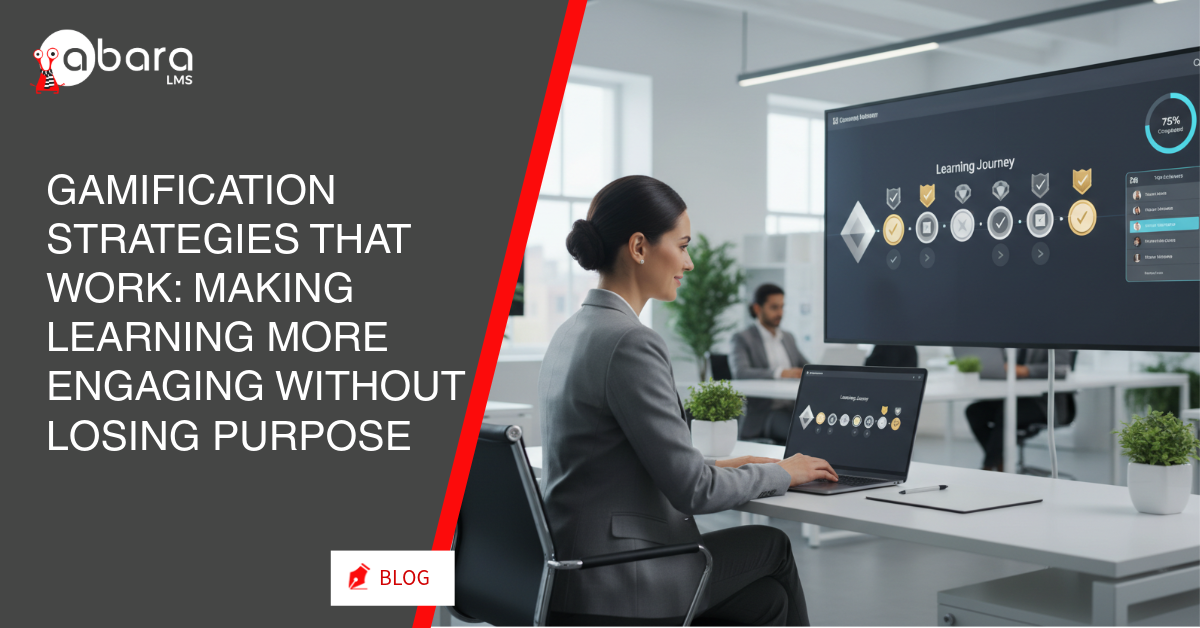
Gamification in corporate learning often starts with a simple idea: add points, badges, or leaderboards and training will become more engaging. The reality is more nuanced. Game mechanics can encourage participation, but simply attaching rewards to course completion does not automatically create meaningful learner engagement.
Effective gamification strategies for corporate training connect motivation with learning goals. They give learners a clearer sense of progress, recognize meaningful achievements, and encourage continued participation without allowing competition to overshadow development. For L&D teams, the question is therefore not whether to gamify training, but where and how gamification can genuinely improve the learning experience.
On this Page
Why gamification works best when it has a purpose
People are motivated by different things. Some enjoy competition, while others respond better to personal progress, recognition, mastery, or the satisfaction of completing a meaningful goal. A successful gamification strategy accounts for these differences rather than assuming every learner wants to reach the top of a leaderboard.
This matters particularly in workplace learning, where audiences can range from new employees completing onboarding to experienced managers developing leadership capabilities. A well-designed employee training LMS can support different learning journeys while allowing gamification to reinforce selected behaviors rather than dominate the entire experience.
The starting point should therefore be the learning objective. Ask what behavior you want to encourage. Is the challenge getting learners to start training, continue through a longer program, complete optional development activities, or build a consistent learning habit? Once that is clear, the right gamification mechanic becomes easier to choose.
Move beyond rewarding course completion
One of the easiest mistakes is rewarding everything equally. If learners receive points simply for opening content or completing every mandatory module, those rewards can quickly lose meaning.
Instead, recognition should reflect achievements that matter. A badge might represent completion of an important learning pathway, development of a specific capability, or achievement of a defined milestone. Points can show cumulative progress across multiple activities rather than rewarding for every click.
This approach is particularly useful for longer development programs. When learners can see smaller milestones along the way, a distant learning goal becomes more manageable. Structured course creation and management also allows L&D teams to organize training around meaningful stages, assessments, and learning activities so that rewards align with actual progress.
Gamification then becomes part of learning design rather than a decorative feature added after the course has been created.
Use competition selectively, not automatically
Leaderboards are among the most recognizable gamification techniques, but they need careful design. A company-wide leaderboard may motivate highly competitive learners while discouraging someone who repeatedly sees themselves near the bottom.
Smaller, relevant peer groups can make competition more meaningful. Depending on the training objective, learners might compare progress within a team, department, role, location, or learning cohort. Abara LMS, for example, supports peer or group-linked leaderboards that can be organized around dimensions such as department, location, role, function, or other groups.
There are also situations where competition should take a back seat. Mandatory regulatory or safety training is primarily about demonstrating knowledge, maintaining certification, and reducing organizational risk. Turning serious compliance requirements into a race for points can send the wrong message.
Organizations managing compliance training and certification should therefore consider recognition based on timely completion, demonstrated knowledge, or certification milestones rather than relying heavily on competitive mechanics.
Design gamification around progress and mastery
Some of the most effective gamification strategies are not really about winning. They help learners see that they are moving forward.
Consider an employee completing a six-month development program. A single certificate at the end provides recognition, but very little encouragement during the journey. Milestones throughout the program can make progress more visible and provide learners with a reason to keep going.
For example, learners could earn recognition after completing foundational learning, passing an assessment, finishing an intermediate stage, and ultimately completing the full pathway. The reward system now tells a story of development rather than simply recording course attendance.
This principle also fits naturally with a broader continuous learning strategy. As organizations work toward building a culture of continuous learning, gamification can help make ongoing development visible and recognizable. The goal is not to make employees collect endless points, but to reinforce the idea that consistent learning and capability development are valued.
Match the strategy to the audience
A gamification model that works for sales training may be unsuitable for leadership development or compliance. Sales teams may respond well to competitive challenges because performance environments already includes targets and peer comparison. New hires may benefit more from progress indicators and onboarding milestones that make an unfamiliar learning journey easier to navigate.
Training companies face another consideration. They may serve multiple clients with different audiences, cultures, and learning objectives. A standardized reward structure across every client can therefore become restrictive. Gamification should be flexible enough to fit the learning context rather than forcing every program into the same engagement model.
L&D teams should also avoid assuming that younger employees automatically prefer gamified learning. Motivation is influenced by role, personality, organizational culture, training relevance, and individual goals. Good learning design starts with those factors, not demographic stereotypes.
Measure whether your gamification strategy is working
Treat gamification like any other learning intervention: observe what happens after it is introduced and adjust accordingly.
If participation increases but assessment performance remains unchanged, the strategy may be encouraging activity without improving learning. If learners initially compete for badges but engagement quickly declines, the rewards may have novelty value without long-term relevance. Conversely, stronger participation in optional learning, more consistent progression through longer programs, or increased return visits can indicate that the approach is supporting the desired behavior.
This is where learning data becomes important. As discussed in using LMS data for strategic decisions, L&D teams can examine learner progress, assessments, participation patterns, and other training data to understand where interventions are working and where adjustments may be needed.
The goal is not to prove that gamification works universally. It is to understand whether a particular gamification strategy is working for a particular audience and learning objective.
Conclusion
The strongest gamification strategies for corporate training are often the most thoughtful not the most elaborate. Points, badges, leaderboards, milestones, and recognition can all support engagement, but their value depends on what behaviors they encourage and how naturally they fit the learning experience.
For L&D teams, that means starting with purpose, recognizing meaningful progress, using competition selectively, adapting the approach to different audiences, and measuring what changes after introducing gamification.
Abara LMS supports gamification through badges, points, and group-linked leaderboards alongside the broader course management and reporting capabilities needed to manage structured learning programs. If you are exploring how gamification can fit into your organization’s learning strategy, Book a Demo to see how Abara LMS can support a more engaging and purposeful learning experience.